
Endangered Species ‘26
The Eyes Are Upon You
The Vanishing
The vaquita: fewer than ten remain.
The staghorn coral: collapsed across 80% of Caribbean reefs in a single generation.
The black rhino: 96% of its population gone in fifty years.
We are not watching numbers fall. We are watching species end.
This project does not address symptoms.
It rebuilds the system.
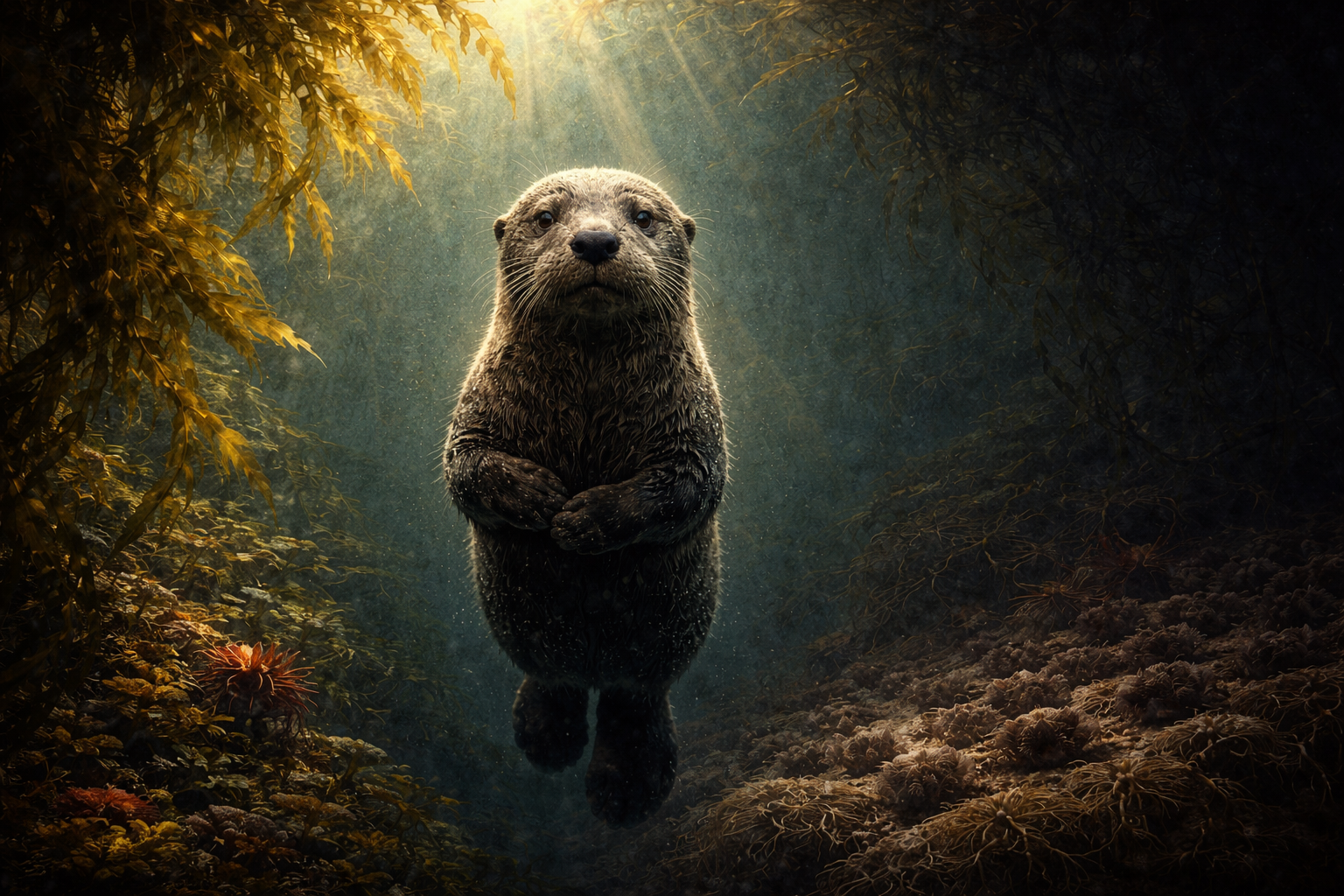
And when a species ends, the ecosystem built around it does not pause and wait. It changes — sometimes catastrophically, sometimes invisibly, always permanently. The sea otter you see on this page is not a symbol. It is a case study. When hunters nearly eliminated the otter from Pacific coastal waters, sea urchin populations exploded unchecked. Kelp forests — the nurseries of the ocean — were consumed. Fisheries that coastal communities depended on for generations collapsed with them. The otter's near-vanishing was not an animal story. It was a food system story. An economic story. A human story.
We are connected to these systems whether we choose to acknowledge it or not. Our neighborhoods, our food chains, our water, our atmosphere — all of it runs through ecosystems we have never visited and species we have never seen. Their destruction does not stay where it begins.
The crisis is not that species are disappearing. It is that we have learned to look away while it happens — and call that looking away something more comfortable, like progress.
These paintings are not memorials.
They are a demand.
_______________________________________________________________________________________________
What Happens If I Don't? — A companion white paper examining ecosystem collapse, cascade consequence, and the cost of inaction. Coming soon.
The Economy
of Protection
This is not charity.
It is infrastructure.
David Attenborough observed that anything you cannot do forever is by definition not sustainable. We have allowed others to strip away the very systems that allow our planet — and our own survival — to continue. Their vanishing is the announcement of ours. That is why the fifteenth work in this collection is not an animal. It is a human eye, looking back.
The organizations doing this work are extraordinary. They have the relationships, the local knowledge, and the trust that takes decades to build. What they rarely have is unrestricted capital that moves at the speed the crisis demands.
This project is designed to work with them — not around them. Proceeds flow through conservation partners to the people they already know: the farmer who needs capital to make regenerative agriculture viable for his family, the coastal fisher whose reef protection makes economic sense if someone makes it worth his while, the former poacher who becomes the most effective game warden in the region because he knows every trail.
Protection has to be worth more than destruction. Not as a moral argument. As an economic fact. That is the infrastructure this project is building — with the people closest to the land, through the partners who already have their trust.
As enterprises within these ecosystems grow — more wildlife, more sustainable yield, more protected habitat — a portion of that incremental revenue returns to the fund. Not as charity repayment. As participation in the outcome they helped create. Capital that redeploys to the next community, the next ecosystem, the next species cluster. The intent is a fund that grows faster than inflation and expenses — one that is still working a generation from now, long after the paintings have found their homes.
The model is being developed in partnership with field organizations whose presence on the ground, accountability infrastructure, and community relationships are the mechanism — not a promise.
A system only survives if it gives more than it takes.
This one is designed to do exactly that.
The Project
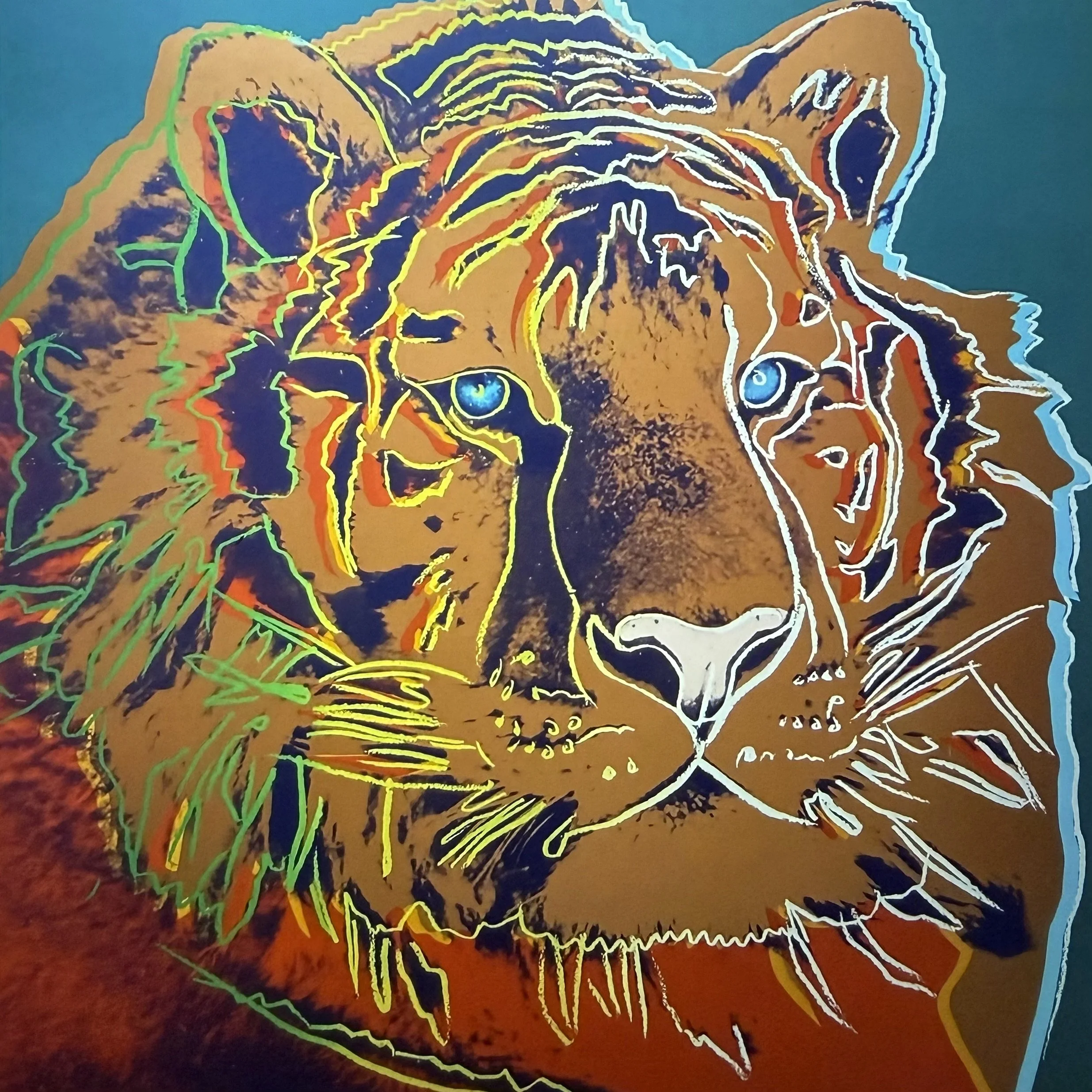
ANDY WARHOL, ENDANGERED SPECIES, 1983
In 1983, Warhol transformed conservation into cultural iconography.
Forty years later, the question has changed. Representation is no longer enough.
Endangered Species '26 extends that lineage into a 15-work system: retaining the black rhino, African elephant, and giant panda, while introducing those now at the edge of disappearance: the vaquita, the polar bear, the staghorn coral.
These works span land, ocean, and atmosphere. Each subject holds a direct gaze. Not an aesthetic choice — a conversation. Each animal looks directly at the person standing before the canvas and makes a wordless request: do something different than what brought me here.
The fifteenth work closes the series with something Warhol never painted: the human eye, looking back. Set against a Rothko-inspired color field — spectral, luminous, warm at the core — it completes the exchange. The witness moves in both directions. We are also the subject.
Old Holland oils on Claessens linen. Materials chosen because someone two hundred years from now will still encounter them. This is not a print. It is a body of work built to outlast the crisis it addresses.
Fifteen works. Every habitat. One system.
The collection is offered in three tiers. There is no open edition. The entire market for original work in this collection is one set. Five further sets each carry one new original. Beyond that, the studio holds its archive and the edition closes.
Founding
Guardian
All fifteen original oils. The complete body of work — every species, every habitat, the human witness — held in a single collection.
The Founding Guardian holds the origin.
Steward
Sets
Each Steward Set includes museum-quality artist-embellished giclees of all fifteen works — archival pigment on canvas, numbered, signed, and Authentified — plus one new original oil. The original is a species chosen in collaboration with the artist, painted to the same standard and scale as the collection.
Each set arrives with the complete Creative Dossier for every work and the Comparative Affinity Matrix establishing primary and modeled future value. Resale royalty protections travel with the original.
Artist
Proofs
The Artist Proof sets are the only place all twenty works exist together — the fifteen collection works plus one giclee of each Steward's chosen species. Museum-quality artist-embellished giclees throughout, numbered, signed, and Authentified.
The Artist Proofs are held in the studio archive. They are the permanent record of the complete edition.
Black
Rhinoceros
Diceros bicornis
Population collapsed 96% in fifty years. Fewer than 6,000 remain across eastern and southern Africa.
Giant
Panda
Ailuropoda melanoleuca
Recovery underway, but habitat fragmentation continues to threaten the 1,800 remaining in the wild.
African
Elephant
Loxodonta africana
The architect of the savanna. Without the elephant, the grassland ecosystems of Africa collapse.
Vaquita
Phocoena sinusFewer than ten remain. The world's rarest marine mammal, found only in the northern Gulf of California.
Polar
Bear
Ursus maritimus
The indicator species of the Arctic. As sea ice retreats, the polar bear becomes the measure of what we have lost.
Staghorn
Coral
Acropora cervicornis
Collapsed across 80% of Caribbean reefs in a single generation. The reef is not a backdrop. It is a food system.
+ additional species · The 15th work: the human witness